-
Federal
Sea Level Trends: Sea Level Variations of the United States Derived from National Water Level Observation Network Stations NGDA
National Oceanic and Atmospheric Administration, Department of Commerce —
Water level records are a combination of the fluctuations of the ocean and the vertical land motion at the location of the station. Monthly mean sea level (MSL)... -
Federal
Maritime Limits and Boundaries of United States of America NGDA
National Oceanic and Atmospheric Administration, Department of Commerce —
NOAA is responsible for depicting on its nautical charts the limits of the 12 nautical mile Territorial Sea, 24 nautical mile Contiguous Zone, and 200 nautical mile... -
Federal
National Status and Trends: Mussel Watch Program
National Oceanic and Atmospheric Administration, Department of Commerce —
Mussel Watch is the longest running continuous chemical contaminant monitoring program in U.S. coastal and Great Lakes waters and was created in response to concerns... -
Federal
National Agriculture Imagery Program (NAIP)
National Aeronautics and Space Administration —
The National Agriculture Imagery Program (NAIP) acquires aerial imagery during the agricultural growing seasons in the continental U.S. A primary goal of the NAIP... -
Federal
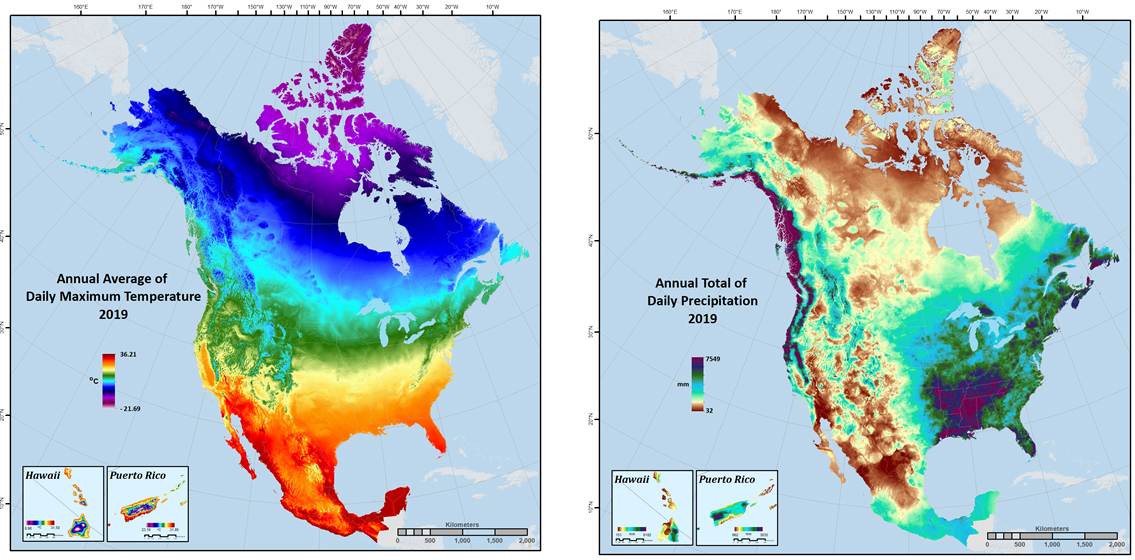
Daymet: Daily Surface Weather Data on a 1-km Grid for North America, Version 4 R1
National Aeronautics and Space Administration —
This dataset provides Daymet Version 4 R1 data as gridded estimates of daily weather parameters for North America, Hawaii, and Puerto Rico. Daymet variables include... -
Federal
National Fish Habitat Action Plan (NFHAP) - Coastal Spatial Framework and Coastal Indicator Data
National Oceanic and Atmospheric Administration, Department of Commerce —
The NFHAP Coastal Spatial Framework and Indicator Datasets consist of a geospatial base layer developed in ArcGIS, and associated data fields joined to the spatial... -
Federal
NACP Site: Terrestrial Biosphere Model Output Data in Original Format
National Aeronautics and Space Administration —
This data set contains the original model output data submissions from the 24 terrestrial biosphere models (TBM) that participated in the North American Carbon... -
Federal
AFSC/ABL: Nearshore Fish Atlas of Alaska
National Oceanic and Atmospheric Administration, Department of Commerce —
NOAA Fisheries Alaska Regional Office and Alaska Fisheries Science CenterâÂÂs Auke Bay Laboratories designed the Nearshore Fish Atlas of Alaska (NFA) to provide... -
Federal
NOAA NCCOS: New England Red Tide Research
National Oceanic and Atmospheric Administration, Department of Commerce —
Alexandrium blooms are one of several algal bloom types often called "red tides," but more correctly referred to as Harmful Algal Blooms (HABs). Alexandrium produces... -
Federal
AFSC/REFM: Alaska groundfish AGEDATA database,1982 to present
National Oceanic and Atmospheric Administration, Department of Commerce —
The AFSC AGEDATA database is a collection of historic and ongoing fish ageing efforts by the Alaska Fisheries Science Center's Age and Growth Program from 1982 to... -
Federal
MODIS/Aqua Near Real Time (NRT) Coarse Sea Ice Extent 5-Min L2 Swath 5km
National Aeronautics and Space Administration —
MODIS/Aqua Near Real Time (NRT) Coarse Sea Ice Extent 5-Min L2 Swath 5km (MYD29L2C) data set contains fields for sea ice by reflectance, sea ice by reflectance pixel... -
Federal
NACP Site: Terrestrial Biosphere Model and Aggregated Flux Data in Standard Format
National Aeronautics and Space Administration —
This data set provides standardized output variables for gross primary productivity (GPP), net ecosystem exchange (NEE), leaf area index (LAI), ecosystem respiration... -
Federal
AVHRR CoastWatch Great Lakes Regional Node Data, May 1991-March 2004
National Oceanic and Atmospheric Administration, Department of Commerce —
The sea surface temperature (SST) products were derived from NOAA's Polar-orbiting Operational Environmental Satellites (POES) for the coastal United States and... -
Federal
MISR Level 1B2 Ellipsoid Data V003
National Aeronautics and Space Administration —
Multi-angle Imaging SpectroRadiometer (MISR) is an instrument designed to view Earth with cameras pointed in 9 different directions. As the instrument flies overhead,... -
Federal
Biologically Important Areas for Cetaceans within U.S. Waters 2015-03-01 - Present
National Oceanic and Atmospheric Administration, Department of Commerce —
The Cetacean Density and Distribution Mapping Working Group identified Biologically Important Areas (BIAs) for 24 cetacean species, stocks, or populations in seven...

Official websites use .gov
A
.gov website belongs to an official government
organization in the United States.
Secure .gov websites use HTTPS
A
lock (
) or https:// means you’ve safely connected to
the .gov website. Share sensitive information only on official,
secure websites.